FSPGX Stock: Fund Holdings, Performance & Key Facts

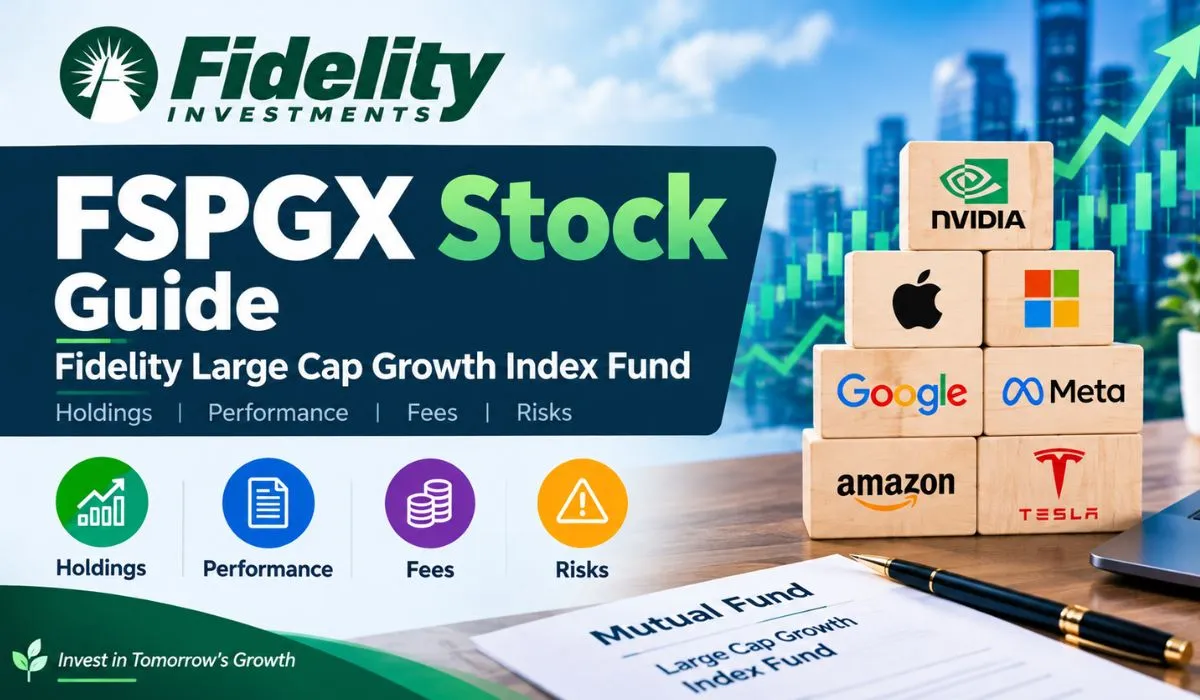
FSPGX stock is the ticker symbol for the Fidelity Large Cap Growth Index Fund, a mutual fund designed to provide investment results that correspond to the total return of large-capitalization U.S. stocks. Rather than representing shares in one individual company, FSPGX gives investors exposure to a portfolio of large U.S. growth-oriented businesses.
The fund is designed for investors interested in the growth-stock segment of the U.S. equity market. However, its performance depends on the securities it holds and broader market conditions, so returns are not guaranteed.
In this guide, we explain what FSPGX is, how it works, which companies it holds, how its fees affect investors, and what to consider before investing.
Quick Answer: What Is FSPGX Stock?
FSPGX is the ticker symbol for the Fidelity Large Cap Growth Index Fund. It is a mutual fund that seeks to track the total return of large-cap U.S. stocks, primarily through exposure to the Russell 1000 Growth Index.
Investors should understand that FSPGX is a mutual fund rather than an individual company’s stock or an exchange-traded fund (ETF). Its portfolio provides diversified exposure to large growth companies, although substantial investments in particular sectors and major holdings can create concentration risk.
For official fund information, visit the Fidelity FSPGX fund page.
What Is the Fidelity Large Cap Growth Index Fund?
The Fidelity Large Cap Growth Index Fund is an investment fund managed by Fidelity. Its investment objective is to provide results corresponding to the total return of stocks of large-capitalization U.S. companies.
According to its June 29, 2026, prospectus, the fund normally invests at least 80% of its assets in securities included in the Russell 1000 Growth Index.
This index represents a segment of the U.S. equity market made up of companies with characteristics associated with growth investing, including relatively higher price-to-book ratios and higher forecasted growth rates.
How Does FSPGX Work?
FSPGX pools investors’ money into a portfolio of securities. Instead of selecting and purchasing each company individually, investors can obtain exposure to a collection of businesses through a single mutual fund investment.
The fund’s value is reflected in its net asset value (NAV), which represents the value of its assets minus liabilities, divided by its outstanding shares.
Because FSPGX follows a growth-oriented index, its performance is influenced by the companies included in that index and changes in their market values.
Is FSPGX a Stock or an ETF?
FSPGX is a mutual fund, not an individual company stock or an ETF.
This distinction matters because mutual funds and ETFs have different trading and pricing arrangements. Mutual fund transactions are generally processed at the next calculated NAV after an order is received in accordance with the fund’s rules, while ETFs trade on exchanges throughout the trading day.
Therefore, investors researching FSPGX should evaluate it as an index mutual fund rather than applying every stock-trading or ETF-related assumption to it.
FSPGX Stock: Key Fund Facts
The following information is based on Fidelity’s published fund information and the fund’s June 29, 2026, prospectus. Figures that change over time should be checked against the latest official data.
| Fund detail | Information |
|---|---|
| Fund name | Fidelity Large Cap Growth Index Fund |
| Ticker symbol | FSPGX |
| Fund type | Index mutual fund |
| Investment focus | Large-cap U.S. growth stocks |
| Benchmark | Russell 1000 Growth Index |
| Fund inception | June 7, 2016 |
| Net expense ratio | 0.035% as reported June 29, 2026 |
| Management approach | Index-oriented investing |
Sources: Fidelity fund overview and SEC-filed prospectus.
Investment Objective
+1
FSPGX Holdings: Which Companies Does It Own?
One of the main reasons investors research FSPGX is to understand its underlying holdings. Because the fund follows a large-cap growth index, its portfolio can include major technology, communications, and other growth-oriented businesses.
Fidelity’s reported holdings as of July 31, 2026, included the following companies:
| Company | Ticker | Portfolio weight |
|---|---|---|
| NVIDIA | NVDA | 14.56% |
| Alphabet | GOOGL/GOOG | 11.73% |
| Apple | AAPL | 7.52% |
| Broadcom | AVGO | 5.63% |
| Microsoft | MSFT | 5.37% |
| Meta Platforms | META | 3.11% |
| Micron Technology | MU | 2.89% |
| Eli Lilly | LLY | 2.85% |
| Tesla | TSLA | 2.83% |
| Advanced Micro Devices | AMD | 2.41% |
Source: Fidelity portfolio data as of July 31, 2026. Holdings and weights can change.
Fidelity Investments
These holdings help explain why FSPGX can be sensitive to technology and artificial-intelligence-related market trends. However, investors should not assume that strong performance from one major holding will automatically produce positive returns for the entire fund.
Is FSPGX Diversified?
FSPGX owns many securities rather than relying on one company alone. Fidelity reported 372 holdings as of July 31, 2026.
Nevertheless, the number of holdings does not tell the whole story. A meaningful share of the portfolio was concentrated in its largest companies, and information technology accounted for 53.44% of the portfolio as of that same date.
Consequently, FSPGX offers exposure to multiple businesses but may be less diversified across sectors than a broad-market index fund.
FSPGX Performance: What Should Investors Check?
Past performance is an important part of evaluating FSPGX, but it should be considered alongside risk, fees, and the benchmark.
Fidelity reported the following average annual returns as of August 31, 2026:
| Performance period | Average annual return |
|---|---|
| 1 year | 10.77% |
| 3 years | 21.08% |
| 5 years | 11.85% |
| 10 years | 17.92% |
Source: Fidelity performance data as of August 31, 2026. Returns for periods longer than one year are annualized; they are not cumulative returns.
Fidelity Investments
These figures describe historical results, not expected future returns. Actual results will vary depending on the investment date, holding period, distributions, and market conditions.
How to Interpret FSPGX Returns
The one-year return can help describe more recent performance, while three-, five-, and ten-year figures provide a broader historical perspective.
However, longer time periods can include very different market environments. A fund that performs strongly over one period may underperform during another, particularly when growth stocks fall out of favor.
Before drawing conclusions, investors should compare FSPGX with its benchmark over identical periods and using consistent return measurements. They should also consider volatility and drawdowns rather than focusing on returns alone.
For the latest NAV, returns, and fund documents, use the official Fidelity FSPGX performance page.
FSPGX Expense Ratio and Fees
The expense ratio is the annual operating cost of a fund expressed as a percentage of assets. It reduces the return investors receive compared with an otherwise identical investment without those costs.
Fidelity reported a net and gross expense ratio of 0.035% for FSPGX as of June 29, 2026. At that rate, the fund’s operating expenses would equal approximately $0.35 per year for every $1,000 invested, assuming the balance remained constant.
| Investment amount | Approximate annual fund expenses |
|---|---|
| $1,000 | $0.35 |
| $5,000 | $1.75 |
| $10,000 | $3.50 |
| $25,000 | $8.75 |
| $50,000 | $17.50 |
These are illustrative calculations, not a bill or a guarantee of actual expenses. Actual costs depend on the investment balance and applicable expense arrangements. Other fees, including intermediary charges where applicable, may also affect the overall cost.
Why Low Fees Matter
Lower operating expenses can help investors retain more of their investment returns over time, all else being equal. However, a low expense ratio does not eliminate market risk or guarantee that a fund will outperform its benchmark or competitors.
Investors should also examine the fund’s investment objective, portfolio concentration, and suitability for their own financial circumstances rather than choosing a fund based on fees alone.
Potential Benefits of Investing in FSPGX
FSPGX may appeal to investors seeking exposure to established U.S. growth companies. Several characteristics are worth considering.
1. Exposure to Large Growth Companies
The fund provides access to a portfolio of large-cap growth businesses through one mutual fund. This can be more convenient than purchasing and managing a long list of individual stocks.
2. Index-Based Investment Approach
FSPGX follows an index-oriented strategy tied to the Russell 1000 Growth Index. This provides a defined investment framework instead of depending primarily on discretionary stock selection.
3. Low Reported Operating Expenses
Its reported 0.035% expense ratio is a notable cost consideration. Still, investors should compare the latest fees of competing funds and account for any additional charges.
4. Access to Multiple Businesses
FSPGX holds securities across a range of companies. This reduces dependence on the fortunes of a single business, although its largest positions and technology exposure can still significantly influence performance.
Risks of FSPGX Stock
Although FSPGX offers access to a broad group of companies, it is not a risk-free investment. Understanding its limitations is essential.
Market Risk
The fund can lose value when stock markets decline. Even established companies can experience significant price declines during recessions, periods of uncertainty, or broader market corrections.
Growth-Stock Risk
Growth stocks are often valued partly on expectations of future earnings expansion. If business results disappoint or investors become less willing to pay high valuations, these stocks can fall sharply.
Technology and Concentration Risk
FSPGX has substantial exposure to information technology and several large individual holdings. If major technology companies or other heavily weighted positions underperform, the fund may experience considerable losses.
Benchmark Risk
FSPGX is designed to follow a growth-oriented index, not the entire U.S. stock market. It may underperform broader-market funds when value stocks or other sectors perform better.
No Guaranteed Returns
Historical returns, favorable ratings, and a low expense ratio cannot guarantee future profits. Investors may receive less than they invested, especially over shorter periods.
FSPGX vs. a Broad-Market Index Fund
Investors researching FSPGX may also compare it with broad-market index funds, such as funds tracking the S&P 500 or total U.S. stock market.
| Feature | FSPGX | Broad-market index fund |
|---|---|---|
| Primary focus | Large-cap growth stocks | A wider selection of U.S. stocks, depending on the index |
| Growth-stock exposure | Central to its strategy | Varies with the benchmark |
| Sector concentration | Can be substantial | Generally spread across more sectors |
| Performance driver | Large growth companies and index composition | Broader market performance |
| Main consideration | Growth and concentration risk | Still exposed to overall stock-market risk |
This is a general comparison, not a claim that one category always performs better. Actual diversification, fees, holdings, and returns depend on the specific competing fund.
How to Invest in FSPGX
Investors considering FSPGX can start by reviewing the fund’s official documents and checking whether it is available through their brokerage or retirement plan.
- Research the fund. Read the latest prospectus, investment objective, holdings, and fee information on Fidelity’s official website.
- Check account availability. Confirm that your brokerage, retirement plan, or investment platform offers FSPGX and review any applicable transaction requirements.
- Understand the costs. Review the expense ratio and any additional fees charged by your intermediary.
- Evaluate your investment goals. Consider your time horizon, ability to tolerate losses, and existing exposure to growth stocks and technology companies.
- Review your investment periodically. Holdings, performance, and market conditions change, so review updated fund information when making investment decisions.
FSPGX is a U.S. mutual fund. Availability, account eligibility, tax treatment, and purchasing procedures can vary by country and platform. Investors outside the United States should verify local access and applicable regulations before proceeding.
Frequently Asked Questions About FSPGX Stock
1. What is FSPGX stock?
FSPGX is the ticker symbol for the Fidelity Large Cap Growth Index Fund. It is a mutual fund that invests primarily in large-cap U.S. growth stocks and seeks to correspond to the total return of its target market segment.
2. Is FSPGX a stock or a mutual fund?
FSPGX is a mutual fund, not an individual company’s stock. It holds a portfolio of securities, allowing investors to gain exposure to multiple companies through one investment.
3. What are the top holdings of FSPGX?
Fidelity’s July 31, 2026, holdings data listed NVIDIA, Alphabet, Apple, Broadcom, and Microsoft among its largest positions. Holdings and their portfolio weights can change, so consult Fidelity’s latest portfolio report for current information.
Fidelity Investments
4. What is the FSPGX expense ratio?
Fidelity reported a gross and net expense ratio of 0.035% as of June 29, 2026. That is approximately $0.35 annually per $1,000 invested, assuming a constant balance and excluding other potential fees.
Fidelity Investments
5. Does FSPGX pay dividends?
FSPGX has made distributions to shareholders. Fidelity’s published dividend history includes distributions in June 2026 and December 2025. Distribution amounts and schedules can change, and a distribution does not necessarily represent investment profit.
Fidelity Investments
6. Is FSPGX a good long-term investment?
That depends on an investor’s objectives, risk tolerance, and existing portfolio. FSPGX may suit someone seeking long-term exposure to large-cap growth stocks, but its sector concentration and sensitivity to growth-stock valuations can create substantial risk. Historical performance alone cannot establish whether it is suitable for a particular investor.
7. Where can investors check the latest FSPGX price and performance?
Investors can use Fidelity’s official FSPGX fund page to review its latest available NAV, performance, holdings, fees, and official fund documents.
Conclusion: Is FSPGX Worth Researching?
FSPGX provides exposure to large U.S. growth companies through the Fidelity Large Cap Growth Index Fund. Its index-oriented strategy, low reported expense ratio, and portfolio of established businesses make it a fund worth understanding for investors researching growth-oriented investments.
However, its substantial technology exposure and concentration in major holdings can increase risk when growth stocks underperform. Investors should evaluate historical performance alongside fees, portfolio composition, diversification, and their own financial objectives