Why Academic Outsourcing is the New Student-Founder Trend


The modern undergraduate experience has shifted from a singular focus on lectures to a multifaceted pursuit of professional “hustle.” Today’s student is often a hybrid: a full-time academic by day and a startup founder, freelance developer, or content creator by night. As the boundaries between the classroom and the boardroom blur, a new productivity trend has emerged—the strategic outsourcing of academic workloads. This isn’t about avoiding work; it’s about managing human capital and high-level opportunity costs.
For a student entrepreneur, time is the most volatile currency. Spending forty hours a week on foundational report writing or repetitive data entry for a minor elective can lead to burnout or, worse, the stagnation of a promising business venture. This is why many high-achievers now choose to pay to do homework through specialized academic consultants. By delegating technical or time-consuming assignments, students can redirect their mental energy toward scaling their businesses, networking with industry leaders, and applying theoretical knowledge to real-world markets.
The Evolution of the “Student-Founder”
The rise of the digital economy has made it possible to launch a global brand from a dorm room. However, the traditional education system often struggles to keep pace with the speed of industry. While a business degree provides the framework, the actual execution of a startup requires a level of immersion that a standard credit-hour semester doesn’t always account for.
Students are no longer viewing their education as a passive rite of passage but as an investment portfolio. In this portfolio, high-tier results are essential for maintaining future credibility, but the process of achieving those results must be optimized. Outsourcing academic tasks allows students to maintain a high GPA without sacrificing the “first-mover advantage” in their professional niche.
Why Time Management Isn’t Enough: The Opportunity Cost Factor
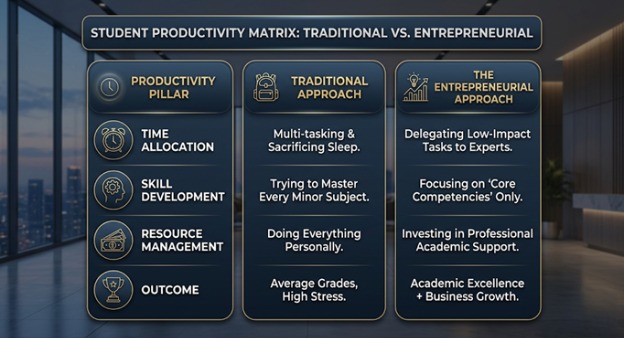
Traditional productivity advice often centers on “waking up at 5:00 AM” or “using Pomodoro timers.” While these are helpful, they don’t address the fundamental issue of volume. When a student is faced with a 5,000-word case study and a critical pitch deck for an investor meeting on the same day, a timer isn’t the solution—delegation is.
| Productivity Pillar | Traditional Approach | The Entrepreneurial Approach |
| Time Allocation | Multi-tasking and sacrificing sleep. | Delegating low-impact tasks to experts. |
| Skill Development | Trying to master every minor subject. | Focusing on “Core Competencies” only. |
| Resource Management | Doing everything personally. | Investing in professional academic support. |
| Outcome | Average grades, high stress. | Academic excellence + Business growth. |
The table above highlights a shift in mindset. In the professional world, CEOs don’t do their own bookkeeping or graphic design; they hire specialists. Student entrepreneurs are simply adopting this corporate logic early. They recognize that their unique value lies in their vision and strategy, not necessarily in the formatting of a 20-page bibliography.
Bridging the Gap Between Theory and Practice
One of the primary criticisms of higher education is the “ivory tower” effect—learning theories that may be outdated by the time a student graduates. Student entrepreneurs often find themselves in a position where they are learning more from their daily business operations than from their textbooks.
By utilizing external support, students can ensure that their academic submissions remain polished and professionally structured. This is where specialized homework services from MyAssignmentHelp become a strategic asset rather than just a convenience. This synergy ensures that the student stays ahead of the curve in both their studies and their career.
Information Gain: The Secret to Recognition
In the modern world, “Information Gain” is a critical metric. It refers to providing new, unique value that hasn’t been rehashed a thousand times. The same principle applies to academic success.
When students outsource the “heavy lifting” of research, they can spend their limited time adding their own unique insights to their projects. They can take the data provided by experts and add their own real-world case studies from their business, making their assignments stand out to professors. This hybrid approach—combining professional research with personal, entrepreneurial experience—is what creates a first-class degree and a first-class career.
Maintaining Integrity in a Digital-First World
A common concern regarding academic outsourcing is the quality and authenticity of the work. To avoid issues, students must choose partners that prioritize experience, expertise, and authoritativeness.
The goal of outsourcing is to enhance the student’s voice, not replace it. Ethical academic support acts as a high-level research assistant. It provides the foundation upon which a student can build. By focusing on quality over shortcuts, students ensure their transcripts reflect their actual capability to manage complex projects—a skill that is arguably more valuable to an employer or investor than the ability to write a poem for a literature elective.
The Global Tone: A Universal Shift in Education
This trend isn’t localized to a single region. From the tech hubs of San Francisco and London to the emerging markets in Dubai and Sydney, the “Student-Entrepreneur” is a global phenomenon. Universities are increasingly becoming incubators for innovation, and as a result, the tools students use to manage their time must also innovate.
Outsourcing is a response to an over-saturated academic environment. It is a tool for survival in a hyper-competitive global market. By treating education as a business process that requires optimization, students are preparing themselves for the realities of the modern workforce, where efficiency and the ability to leverage external talent are the keys to leadership.
FAQ: Navigating Academic Outsourcing
Q: Is outsourcing academic work considered a shortcut?
Ans: It depends on how you use it. For entrepreneurs, it is a form of strategic delegation. It allows you to maintain academic standards while focusing your primary energy on professional growth and innovation.
Q: How do I ensure the content doesn’t look out of place?
Ans: Always work with reputable services that focus on high-authority research and custom drafting. Ensure the final product is reviewed and tweaked to match your personal voice and includes your unique insights from your business ventures.
Q: Can this actually help my career?
Ans: Yes. Managing a business and a degree simultaneously teaches you project management, delegation, and resource allocation—skills that are highly sought after in the corporate world.
Q: Is it possible to rank for high-authority keywords in this niche?
Ans: By providing unique perspectives—like the “Human Capital” angle discussed here—and following SEO best practices (like proper heading structures and natural link integration), content in this niche can effectively reach a wide audience.
Conclusion: The Strategic Advantage
The transition from a traditional student to a “Student-Entrepreneur” requires a complete overhaul of one’s productivity mindset. By embracing the trend of academic outsourcing, students are not just buying time; they are investing in their future. They are choosing to excel in a global economy that rewards those who know how to manage resources effectively. Whether it is through navigating the complexities of a startup or ensuring their GPA remains competitive through professional support, the modern student is a master of efficiency. In 2026, the most successful individuals aren’t those who do everything themselves—they are those who know exactly what to delegate so they can focus on what truly matters.